
Services
Tree surgery across Ash, Aldershot and the Surrey border
Climbing and rigging work on mature trees, from careful pruning to full sectional dismantling where there is no room to fell.
Tree surgery is the climbing and cutting work that keeps a mature tree safe, healthy and in proportion with the space around it. It runs from a light prune on a garden fruit tree to taking a large conifer down in sections over a greenhouse.
What tree surgery covers
Tree surgery is a broad term for work carried out on a standing tree, usually by a climber. In a domestic garden around Ash, Aldershot or Farnham that normally means one of a handful of jobs: clearing deadwood, lifting the lower limbs for headroom, thinning a dense canopy to let light through, reducing height and spread, or taking the tree down altogether.
The right job is rarely the biggest one. A tree that feels oppressive in July often only needs the crown thinned and the lowest branches removed, which changes the light in a garden more than people expect. Cutting hard into a tree every few years is worse for it, and dearer over a decade, than a lighter cut at sensible intervals.
- Deadwood removal, taking out dead, dying or hanging branches
- Crown lifting, raising the lowest limbs for clearance over a lawn, path or drive
- Crown thinning, removing a proportion of the smaller branchwork to reduce density
- Crown reduction, shortening branches back to suitable growth points
- Sectional dismantling, where a tree cannot safely be felled whole
- Pollarding, and the ongoing maintenance of trees already managed that way
Climbing and rigging in a tight garden
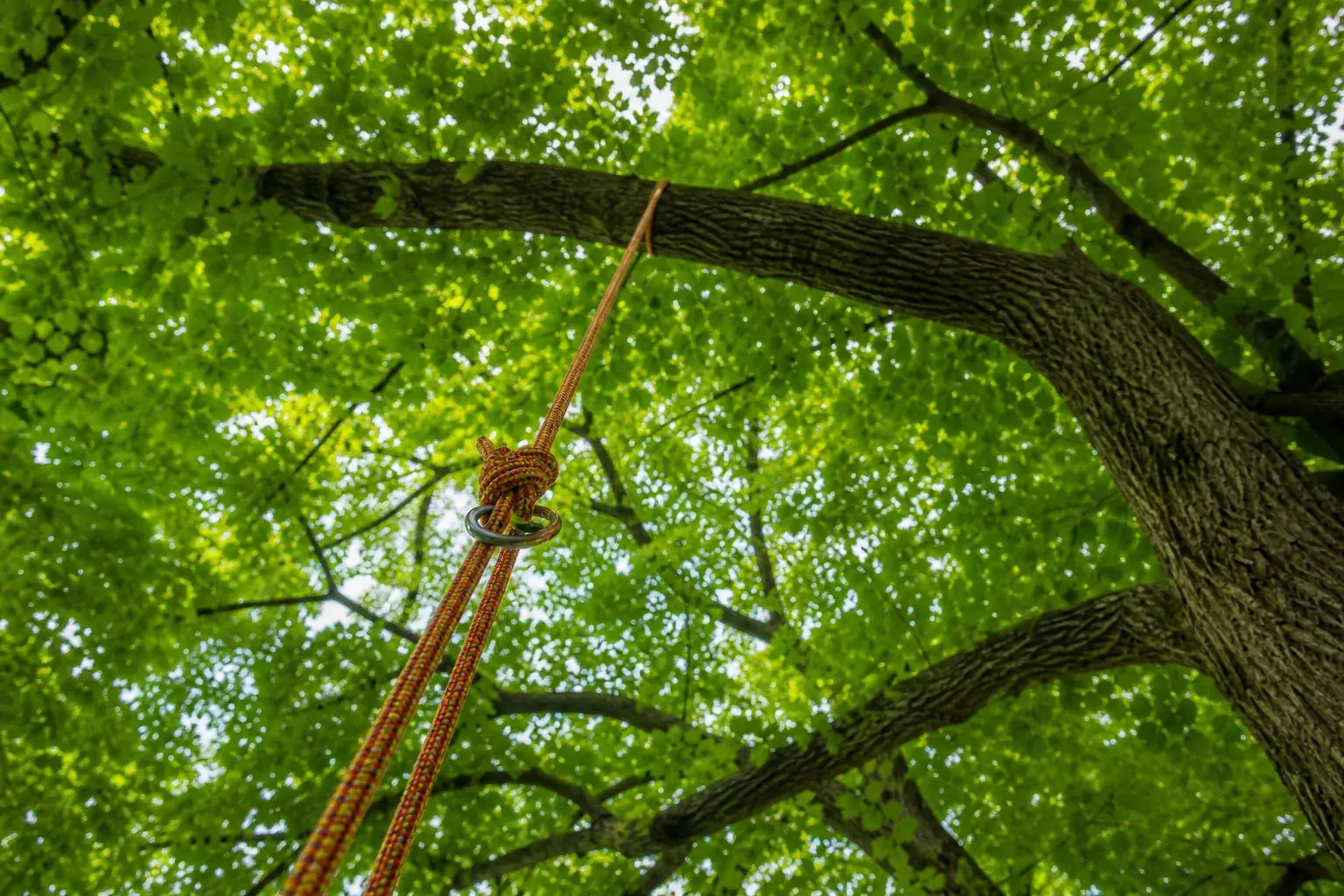
Most trees in gardens around here sit close to something that matters: a house, a conservatory, a greenhouse, a neighbour’s fence or a parked car. Where there is no clear drop zone, limbs are not simply cut and allowed to fall. They are roped to an anchor point higher in the tree, cut, then lowered under control to a groundworker.
Rigging is the slow part of the job and the part that protects everything underneath. The climber works outward along a limb and takes it in short lengths so no single piece overloads the rope, while the groundworker runs the lowering device and takes the weight through friction. Done properly, a large limb lands quietly on the lawn rather than dropping onto it.
Where access allows, a mobile platform can be quicker and safer, particularly on a stem with decay that may not be sound enough to climb. Which method suits a tree is decided on site rather than from a photograph.
Reading the tree before anything is cut
A sensible prune starts with a look at the whole tree from the ground: the balance of the crown, where the weight sits, the condition of the bark, fungal brackets near the base, and whether the soil on one side has lifted. Deciding what to remove before you understand how a tree holds itself up is how trees get ruined.
Species matters just as much. A birch and a lime respond very differently to the same cut. Some trees compartmentalise wounds well and others seal slowly, which is why a cut that causes a sycamore no trouble can let decay straight into the stem of a cherry. Pruning back to a growth point, just outside the branch collar, gives the tree the best chance of closing the wound.
Nesting birds, bats and protected trees
Under the Wildlife and Countryside Act 1981 it is an offence to intentionally damage or destroy the nest of any wild bird while it is in use or being built. The main nesting season runs from roughly March to August, so work in that window needs the tree checked beforehand and stopped if an active nest is found. Bats and their roosts are protected separately, all year round.
Trees can also be protected in planning terms. A Tree Preservation Order means written consent from the local authority before any pruning or felling. In a conservation area, six weeks’ written notice must be given so the council can decide whether to make an Order. Both duties sit with the tree owner, so it is worth checking with the council before booking anything.
Clearing up afterwards
Brash is chipped on site wherever there is room for the chipper, which turns a startling volume of branchwood into a few barrows of woodchip. Chip can be left behind for borders and paths if it is useful to you, or taken away with everything else. Cordwood is cross cut into manageable lengths and either stacked for your own log pile or removed.
What drives the cost of tree surgery is mostly awkwardness: the size of the tree, how far arisings have to be carried, whether a vehicle can get near, how close the buildings are, and whether the tree is protected. Those are the useful things to mention when you first get in touch, because they shape the job far more than the species does.
Worth reading first
- Signs a tree is unsafe, and when to call an arboristThe things worth looking for on your own trees, from fungal brackets and bark cracks to a lean that has changed, and what warrants a professional opinion.
- When to prune a tree, and why timing mattersWhy most broadleaf pruning happens in winter, which species are exceptions, how apple and other fruit trees differ, and the legal limits during nesting season.
- Choosing a tree surgeon, and what drives the costWhat separates a competent outfit from a cheap one, what actually moves the price of a removal or a prune, and whether a stump is worth grinding out.
Questions
Tree Surgery questions
The things people usually want to know before booking this work in.
Discuss your trees or your garden
Tell us what you are dealing with and we will arrange a time to come and look. No obligation either way.
- Office hours
- Monday to Friday, 09:00 to 17:00
Saturday and Sunday, closed - Based in
- Ash, Aldershot
Surrey GU12 6SD