
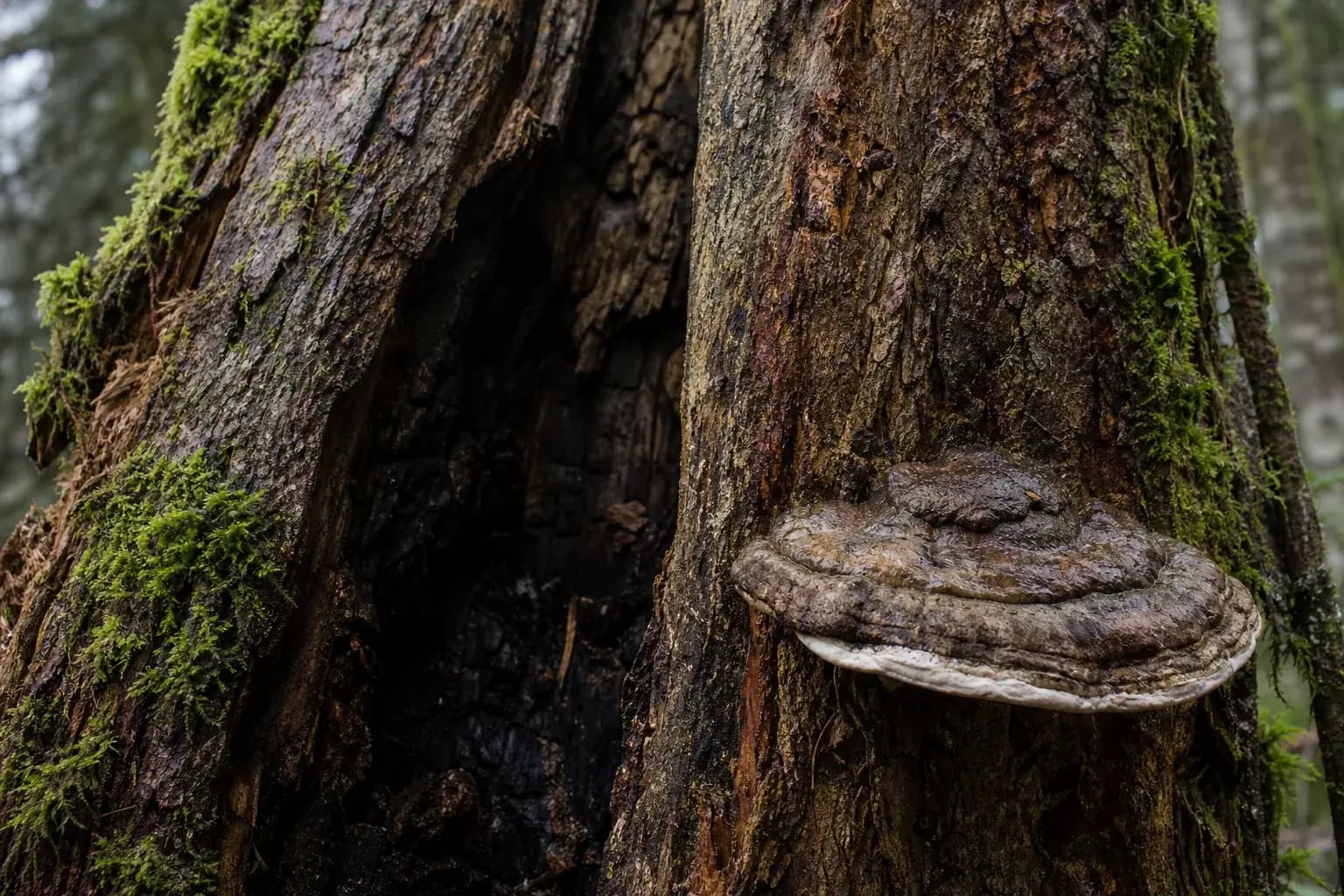
A tree that is failing usually gives some warning, though the signs are easy to miss if you are not looking for them. This guide covers what is worth checking on your own trees through the year, what each sign tends to indicate, and the point at which a professional inspection becomes the sensible next step.
What you can check from the ground
Most useful observation needs nothing more than a slow walk around the tree in good light. Look at the trunk from every side, then step back far enough to see the whole crown against the sky. Compare what you see with the same tree last summer, and with its neighbours of the same species. Trees rarely fail without a period of visible change.
Twice a year is enough for most gardens, ideally once in full leaf and once when the branches are bare. Winter shows structure, old wounds and broken stubs. Summer shows how much of the crown is actually working. Keep a photograph on your phone each time, taken from the same spot, because a lean or a crack is far easier to judge against an image from twelve months earlier.
- Fungal brackets or clusters of toadstools on the trunk, at the base or on exposed roots
- Vertical cracks, bulges or weeping patches on the main stem
- Tight upright forks where two stems press against one another
- Dead branches held in the canopy, particularly in the upper third
- Thin foliage or undersized leaves in one part of the crown
- Soil at the base that has lifted, cracked or pulled away from the trunk
- Recent trenching, paving or changes in ground level under the canopy
Fungal fruiting bodies, and what they suggest
A fruiting body is the visible part of something that has usually been working inside the tree for years, so both the species and its position matter. Brackets on the lower trunk or at the base point to decay in the part of the tree carrying the greatest load, which is the more serious case. The same fungus on a limb that is already dead is a smaller problem.
A few are common enough to recognise. Honey fungus shows as honey-coloured toadstools around the base in autumn, with flat black strands like bootlaces under the bark. Ganoderma forms hard, shelf-like brackets low on the stem and is associated with root and butt decay. The giant polypore appears as large overlapping fans at the foot of beech, and degrades the roots while the crown still looks healthy.
Do not pull brackets off. They are evidence, and removing them changes nothing about the decay inside the stem. Photograph them, note where they are growing and in which month, then ask for an opinion. The question that matters is not only which fungus it is, but how much sound wood is left around the decay, and that takes a proper inspection.
Cracks, cavities and included bark at forks
A vertical crack running down the stem, or a seam that opens and closes as the tree moves in wind, suggests the trunk is already working as two pieces rather than one. Cavities are less straightforward. A hollow trunk with a sound outer wall can be perfectly stable, because a tube is a strong shape, while a modest cavity with thin, soft walls may not be.
Included bark is the one most people walk past. Where two stems rise at a narrow angle, bark can become trapped between them instead of the wood knitting together, so the union looks solid but has little structural connection. These forks are a frequent failure point in mature limes and ornamental pears. A dark seam at the fork, or a bulge either side of it, is worth photographing and asking about.
Deadwood, dieback and late leafing
Some deadwood is normal. Lower branches shaded out by the canopy above will die back and shed, and in a garden away from paths and seating that is no great concern. Deadwood high in the crown is read differently, because it often reflects a problem at the roots rather than at the branch itself. Progressive dieback working inwards from the tips is the pattern to watch.
Late leafing and sparse foliage tell a similar story. If one tree in a row comes into leaf a fortnight behind the others, or carries noticeably smaller leaves than it did two summers ago, something is limiting what the roots can supply. Drought, compaction, a severed root and root decay all produce that result, so it is a prompt to investigate rather than a diagnosis.
A lean, and the ground around the base
A long-standing lean is usually not an emergency. Trees that have grown at an angle towards light, or away from a building, lay down reaction wood to compensate and are often entirely stable. The tell is the shape of the trunk: a gentle curve that straightens towards the top suggests the lean developed slowly, and the ground at the base will be settled and undisturbed.
A lean that has recently changed is a different matter. Check the soil on the side away from the lean for heaving, cracking or a raised lip of turf. Exposed roots on the lifting side, a gap opening between the trunk and the soil, or a tree that has visibly moved after a windy night all warrant a prompt professional look rather than a wait-and-see approach.
Root damage from trenching, paving and level changes
Most of a tree’s roots sit in the top half metre of soil and spread well beyond the edge of the canopy, which is why so much root damage happens by accident. A service trench cut across one side, a drive laid over the root area, a raised bed built against the trunk or a change in ground level can remove or suffocate a large share of the root plate in an afternoon.
The effects take time to appear. Thinning in the crown, dieback on the side where the roots were cut and reduced stability often show up one to three growing seasons later, by which point the cause is easy to overlook. If building work has happened near a mature tree, say so when you ask for an inspection, because it changes how the tree should be assessed.
Storm-hung limbs, and what counts as urgent
After a gale, look up before you tidy up. A limb that has torn out but lodged in the canopy can sit there for weeks and come down without warning in light wind. The same applies to a split branch still attached by a strip of bark. Neither is a ladder job, and neither should be poked at from below.
Keep people and vehicles out from under anything you are unsure about, and ask for help rather than attempting the work yourself. Our approach to storm damage and emergency tree work is to make the tree safe first and tidy up afterwards, which usually means rigging the loose material down under control rather than letting it drop onto whatever is below.
- A branch hanging in the canopy, or split and still partly attached
- A tree leaning onto a building, a fence, a road or a power line
- Soil lifting or cracking at the base after a storm
- A fresh crack in the main stem, or a fork that has visibly opened
- Any tree touching overhead cables, which is a matter for the network operator