
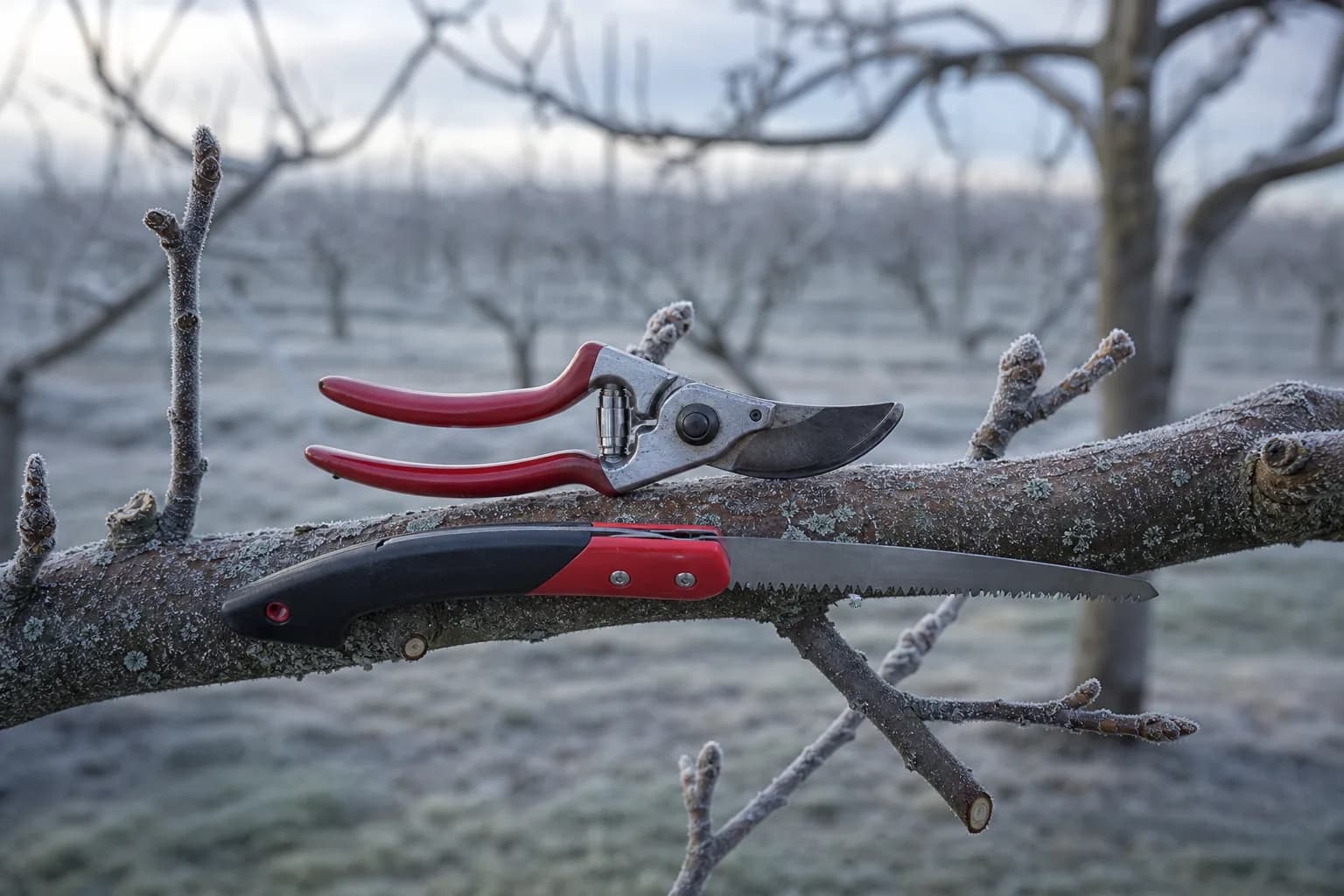
Timing changes how well a tree recovers from pruning, how much it regrows and, in a few species, whether it picks up disease through the cuts. This guide sets out the general dormant-season rule for broadleaves, the species that are deliberate exceptions, how fruit trees differ, and the legal limits around nesting birds.
Why most pruning happens in the dormant season
For the majority of broadleaved trees, the window from late autumn to late winter is the default. The tree is dormant, the structure is visible without leaves, there is no nesting activity to work around, and the wounds sit through a cold period when most decay fungi are releasing fewer spores. Ground conditions are the one drawback, since heavy machinery on a wet lawn in February does more visible damage than the pruning itself.
Working on bare branches also produces better decisions. Crossing limbs, old stubs, included bark at forks and the true extent of deadwood are all far easier to read in January than in July. A reduction planned in winter can follow the tree’s natural shape properly, because the person doing it can see where every cut will leave the outline.
The exception to the dormant rule runs in both directions, and it is emergency work. A broken or hanging limb is dealt with when it happens, whatever the month, because the risk of leaving it in place outweighs any argument about ideal timing.
The species that are exceptions
A handful of common garden trees should not be pruned in winter at all, and the reasons differ. Some are disease-related, some are simply about sap flow, and a couple are about how poorly the wounds close in cold weather. Getting these wrong rarely kills a tree outright, but it can shorten its life or leave it looking a mess for several seasons.
- Prunus species, which includes ornamental and fruiting cherry, plum, damson and almond, are pruned in late spring or summer while in active growth, to reduce the risk of silver leaf and bacterial canker entering the cuts
- Birch and maple, including sycamore, bleed heavily if cut in late winter or early spring as the sap rises, so late summer or early autumn is preferred
- Walnut bleeds for the same reason and is best pruned in late summer
- Magnolia closes wounds poorly in cold conditions and is usually pruned from midsummer into early autumn
- Yew is unusually tolerant and can be cut hard in spring, which is why an old yew hedge can be reclaimed where a conifer hedge cannot
Apple, pear and other fruit trees
Apples and pears are pruned in winter for structure. With the tree dormant, you can open the centre, take out crossing and congested growth and shorten leaders, and the tree responds in spring with vigorous new shoots near the cuts. That vigour is the point when a young tree is being trained, and the reason winter pruning is the wrong tool if the aim is to make an established tree smaller.
Summer pruning does the opposite. Cutting in August, once the new growth has firmed up at the base, removes leaf area at the moment the tree is building reserves, which restrains growth rather than stimulating it. This is the standard approach for trained forms such as cordons, espaliers and fans, and it also improves light and air around ripening fruit. Many gardeners use both: winter for the framework, summer to keep it in bounds.
Stone fruit sits outside this pattern. Plums, cherries, damsons and gages are pruned in late spring or summer only, never in winter, because of the risk of silver leaf. If a plum looks as though it needs attention in January, the sensible answer is to wait.
Why topping is damaging, and what reduction means instead
Topping is the practice of cutting the crown back to stubs at an arbitrary height, with no regard for where the cuts fall. It is still offered, usually cheaply, and it does lasting harm. The large wounds it leaves are at the worst possible place for the tree to seal, so decay gets a route into the main stem, and removing most of the leaf area at once leaves the tree short of the energy it needs to defend itself.
What follows is the real problem. The tree responds with a dense flush of upright shoots from around the cuts, attached only to the outer layers of wood rather than anchored into the stem. Within a few years the tree is taller, denser and heavier than before, with weakly attached growth sitting on decaying stubs. It then needs cutting again, more often, and the eventual cost of dealing with it is far higher.
A crown reduction does something different. Each cut is taken back to a suitable side branch large enough to take over as the new growing point, so the wounds are smaller, the tree keeps a natural outline and the regrowth is properly attached. The recognised industry guidance, British Standard 3998, describes reduction in exactly these terms, and it is the method we work to.
Hedges, nesting birds and the law
Under the Wildlife and Countryside Act 1981 it is an offence to intentionally damage or destroy the nest of any wild bird while that nest is in use or being built. The duty applies all year, not only in spring, and it rests on whoever carries out the work. The main nesting season in the UK runs roughly from March to August, which is why most contractors avoid routine hedge cutting across those months.
In practice that means hedge work is best planned for late summer through to the end of February, and that any cut inside the season needs the hedge checked for active nests immediately beforehand. If a nest is found, work stops in that section until the young have fledged. Separate rules apply to countryside hedgerows and to farm land, so a boundary hedge on agricultural ground is worth checking before anything is cut.
Evergreens and conifers
Evergreen hedges such as laurel, privet and box are usually cut from late spring into summer, once the risk of hard frost has passed and growth is under way. Cherry laurel has large leaves that look shredded after a hedge cutter, so secateurs give a far better finish on a prominent hedge, slow though it is. Avoid cutting box in strong sun, which scorches the fresh cuts.
Conifers need more care, because most of them, including Leyland cypress, thuja and spruce, carry no dormant buds in the old brown wood. Cut back beyond the green and the hedge stays brown there permanently. Height and sides can be kept in check with regular light trims through spring and summer, but a conifer hedge that has already outgrown its space cannot simply be cut back hard and expected to recover. Yew is the exception, and will break from old wood.