
Services
Commercial grounds maintenance
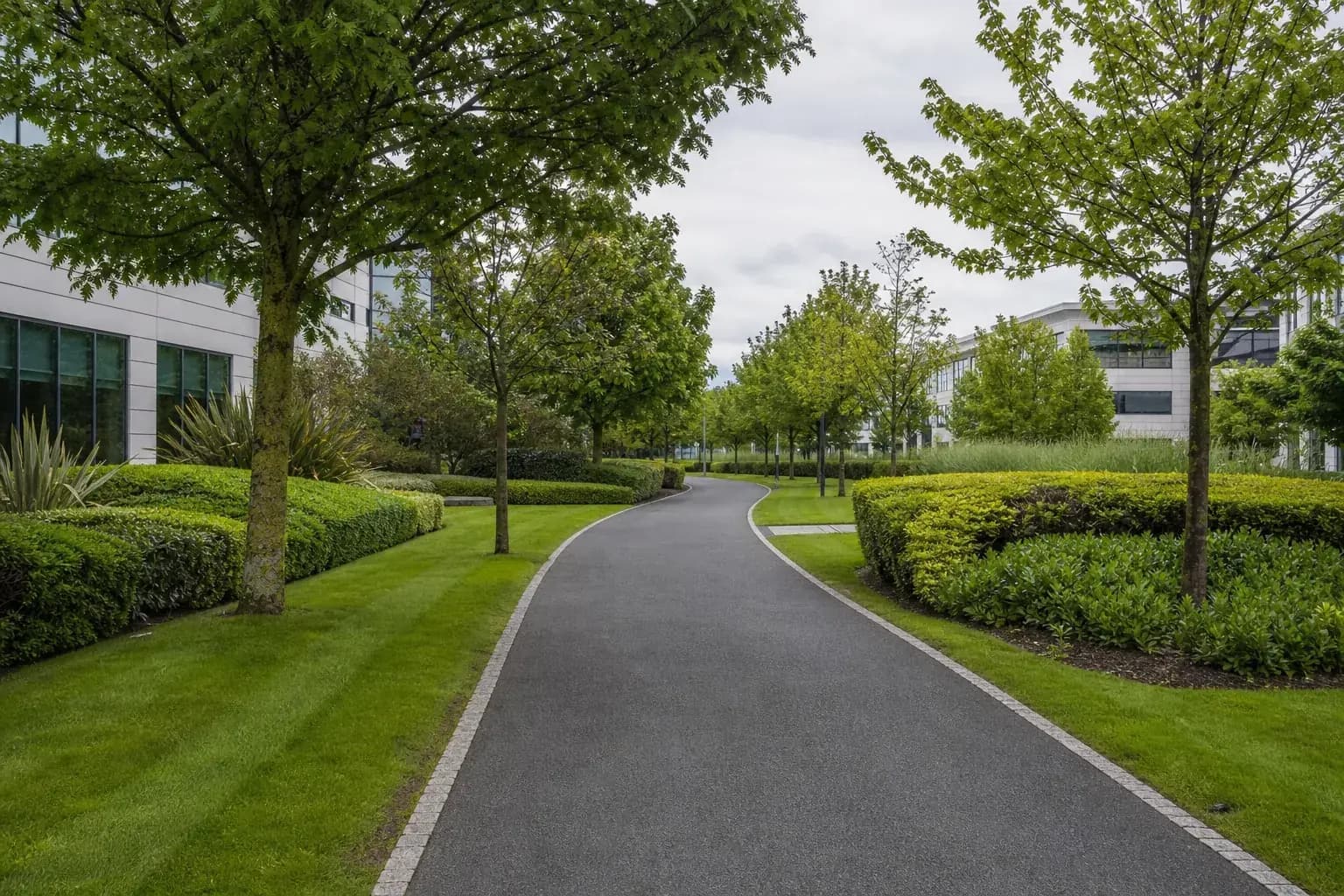
Scheduled grounds care for businesses, estates, schools and managing agents, worked around the site being in use.
Grounds that belong to a business, a school, an estate or a managed block need to look consistently cared for rather than rescued twice a year. Scheduled maintenance keeps them that way, worked around the site being in use.
A schedule rather than a series of call outs
Commercial grounds work differently from domestic gardens. The aim is a steady standard across the year at a predictable cost, which means a defined schedule of visits with a clear scope for each one, rather than reacting when the grass gets long enough for someone to complain.
A typical programme runs on a regular grass cutting cycle through the growing season, with hedge cuts, shrub bed work, border maintenance and leaf clearance timed to the season, and winter visits used for pruning, edging and the jobs that are easier when nothing is growing. The schedule is set to the site, since a business park verge and a school field have very different requirements.
- Grass cutting on a set cycle through the growing season, with edges maintained
- Hedge cutting, shrub bed maintenance and border weeding
- Leaf clearance in autumn, prioritising paths, car parks and drainage gullies
- Hard surface upkeep, including weed control on paths and car parks
- Seasonal tree work, including deadwooding and crown lifting over paths and parking
- Winter pruning, edging and renovation work outside the growing season
Working around a site that is in use
The practical constraints on a commercial site are rarely horticultural. Staff and visitors are walking through, deliveries arrive, cars sit in the bays you need, and a school has a very clear view about when machinery may run. Planning around that is most of the job, and often means early starts, holiday period work, or taking a site in sections.
Work is set up so that pedestrians and vehicles are routed clear of what is happening, with the area signed and cordoned, and the site left clean rather than being left as a hazard between visits. Where a managing agent or facilities team needs notice of visits and a record of what was done, that can be built into the arrangement.
Trees on commercial land and duty of care
Anyone in control of land owes a duty of care to people on it and to those passing by, under the Occupiers’ Liability Acts and ordinary common law. For trees that means knowing roughly what you have, looking at it at sensible intervals, and acting on what the inspection finds. Keeping a record of that process matters, because a reasonable system of inspection is the defence if a limb does come down.
In practical terms, a periodic walk round noting condition, deadwood, clearance over paths and parking, and any obvious defects will catch most issues long before they become urgent. Trees overhanging an adopted highway or footway bring an additional obligation to maintain clearance, which the highway authority can enforce.
Ash dieback and tree populations on larger sites
Any site with a boundary of mature ash is now dealing with ash dieback, caused by the fungus Hymenoscyphus fraxineus. Infected trees thin from the top down and become brittle as the disease progresses, which makes them increasingly hazardous to climb and increasingly expensive to deal with if left.
The sensible approach on a larger site is to identify the affected trees early, prioritise those over paths, car parks, buildings and boundaries, and phase the work rather than face the lot in one year. Some ash show tolerance and are worth retaining where they are away from targets, so blanket removal is rarely the right answer.
Setting up an arrangement
A site visit and a walk round with whoever is responsible for the grounds is the starting point. From that comes a written scope, visit frequency and a schedule across the year, so the cost is known in advance and both sides are clear on what each visit includes.
Scopes are not fixed for ever. Sites change, planting matures, and priorities shift when a car park extension removes a border or a new tenant wants the frontage sharper. The arrangement is reviewed as needed rather than carried on unchanged out of habit. Additional work outside the schedule, such as storm damage or a tree removal, is quoted separately.
Worth reading first
- Signs a tree is unsafe, and when to call an arboristThe things worth looking for on your own trees, from fungal brackets and bark cracks to a lean that has changed, and what warrants a professional opinion.
- When to prune a tree, and why timing mattersWhy most broadleaf pruning happens in winter, which species are exceptions, how apple and other fruit trees differ, and the legal limits during nesting season.
- Tree Preservation Orders and conservation areasWhat a TPO means for work on your own tree, what is different in a conservation area, and the notice the council expects before anything is cut.
Questions
Commercial Grounds Maintenance questions
The things people usually want to know before booking this work in.
Discuss your trees or your garden
Tell us what you are dealing with and we will arrange a time to come and look. No obligation either way.
- Office hours
- Monday to Friday, 09:00 to 17:00
Saturday and Sunday, closed - Based in
- Ash, Aldershot
Surrey GU12 6SD