
Services
Tree felling and removal
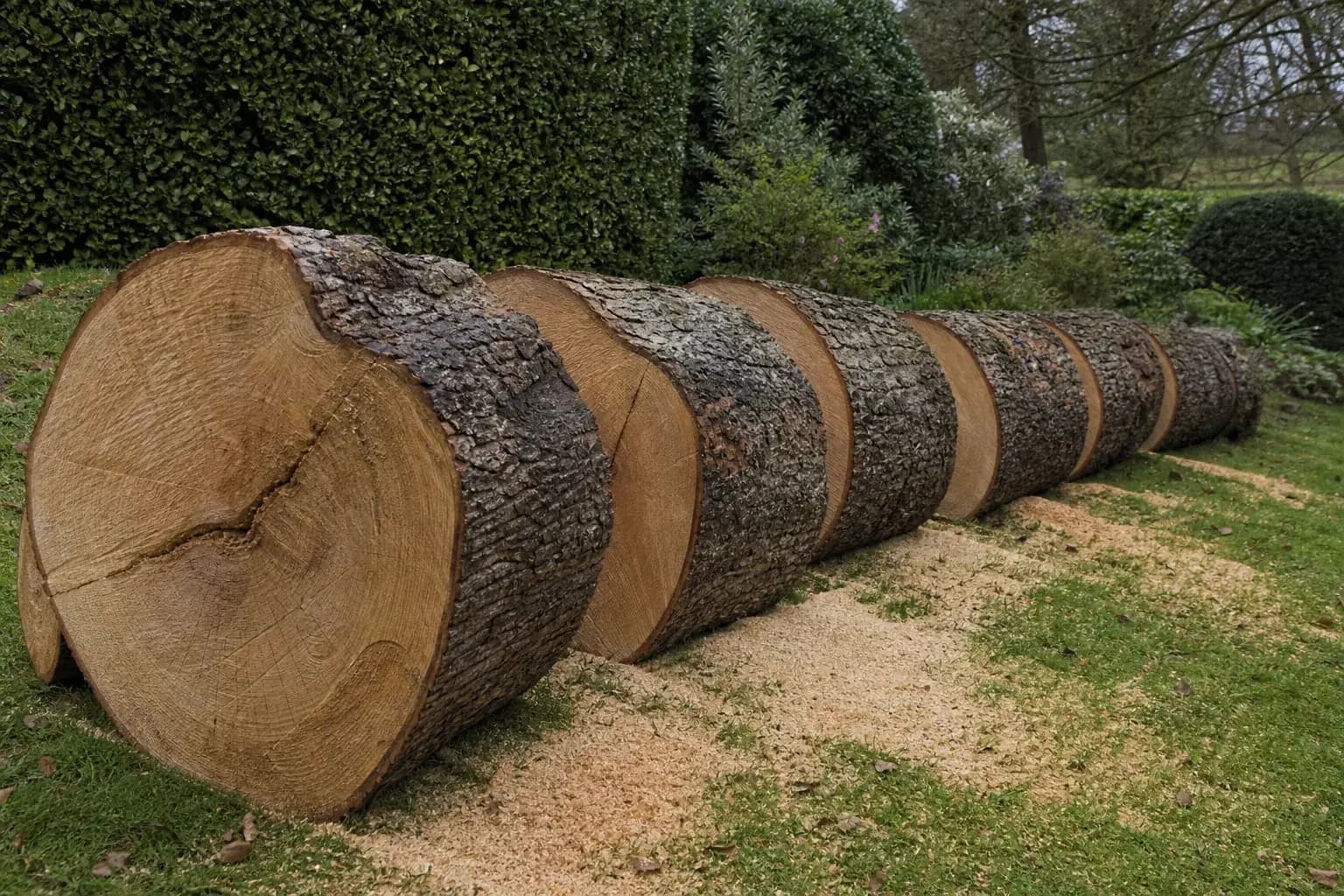
Straight felling where there is space to drop a tree, and sectional dismantling where there is not. Timber and brash cleared.
Some trees have to come out: dead, unstable, outgrowing the plot or in the way of building work. Depending on the space available that means either a straight fell or taking the tree down piece by piece from the top.
When removal is the right answer
Removal is a last resort on a healthy tree, because a mature tree takes decades to replace and usually does more good in a garden than people credit it for. It becomes the sensible option when a tree is dead or dying, when decay has gone far enough into the stem or roots to make failure likely, when it has been badly damaged in a storm, or when it is simply the wrong tree in the wrong place.
Outgrowing the plot is a common reason around here. A conifer planted as a hedge forty years ago and never topped, or a self-seeded sycamore behind a shed, reaches a size where no amount of pruning makes it work. Repeatedly cutting back a tree that is far too large for its position costs more over time than removing it and replanting something suited to the space.
Straight felling and sectional dismantling
Where there is a clear area at least as long as the tree is tall, and no structures, services or neighbours in the fall path, a tree can be felled in one piece. That involves a directional cut on the face, a back cut leaving a hinge of uncut wood to steer the fall, and wedges or a pull line to control direction. The hinge, not the saw, is what governs where the tree goes.
Most gardens do not offer that room. In a typical back garden the tree is dismantled instead: a climber works from the top down, removing branches and then cutting the stem in short lengths, with everything roped and lowered rather than dropped. It is slower and more labour intensive than felling, which is why access has such a large effect on the price of a removal.
Permissions and the paperwork before the saw
Felling a protected tree without consent is a criminal offence, so the status of the tree is checked first. If a Tree Preservation Order applies, a formal application goes to the local planning authority and work waits for a decision. In a conservation area, a section 211 notice gives the council six weeks to respond, during which nothing may be cut.
There are limited exemptions, including trees that are genuinely dead or that present an immediate risk, but these are narrower than people assume and usually still need notice and evidence. Felling licences from the Forestry Commission come into it for larger volumes of timber removed from woodland, rather than for garden trees.
- Check whether a TPO applies, or whether the property sits in a conservation area
- Allow six weeks for a conservation area notice, or longer for a TPO application
- Check for nesting birds if the work falls between March and August
- Consider boundary ownership where a tree sits on or near the line
- Think about what replaces it, and whether a planning condition requires replanting
What is left behind
Felling leaves a stump and, depending on what you asked for, a stack of cordwood. The stump can be cut flush to the ground, left tall enough to be ground out later, or ground out as part of the same visit. Leaving a stump is perfectly acceptable if the ground is not being reused, though it will eventually host fungi and may send up suckers on species like poplar, cherry and lime.
Brash is chipped and removed, or left if you have a use for the chip. Timber is cross cut and can be stacked on site, which saves on disposal and gives you firewood once it has seasoned properly, generally a year or more for most hardwoods. Whatever is not wanted is taken away so the ground can be made good.
What drives the cost of a removal
Size is the obvious factor, but access tends to matter more. A large tree with a chipper parked alongside it can work out more straightforward than a medium tree in a back garden reached only through the house or along a narrow side passage, where every piece is carried by hand.
Proximity to buildings, overhead cables, conservatories and boundaries adds rigging time. Disposal volume, whether the stump is being ground, and whether the tree is protected all feed in as well. A site visit is the only honest way to price any of it, because photographs rarely show the access or the ground conditions.
Worth reading first
- Signs a tree is unsafe, and when to call an arboristThe things worth looking for on your own trees, from fungal brackets and bark cracks to a lean that has changed, and what warrants a professional opinion.
- Tree Preservation Orders and conservation areasWhat a TPO means for work on your own tree, what is different in a conservation area, and the notice the council expects before anything is cut.
- Choosing a tree surgeon, and what drives the costWhat separates a competent outfit from a cheap one, what actually moves the price of a removal or a prune, and whether a stump is worth grinding out.
Questions
Tree Felling & Removal questions
The things people usually want to know before booking this work in.
Discuss your trees or your garden
Tell us what you are dealing with and we will arrange a time to come and look. No obligation either way.
- Office hours
- Monday to Friday, 09:00 to 17:00
Saturday and Sunday, closed - Based in
- Ash, Aldershot
Surrey GU12 6SD