
Services
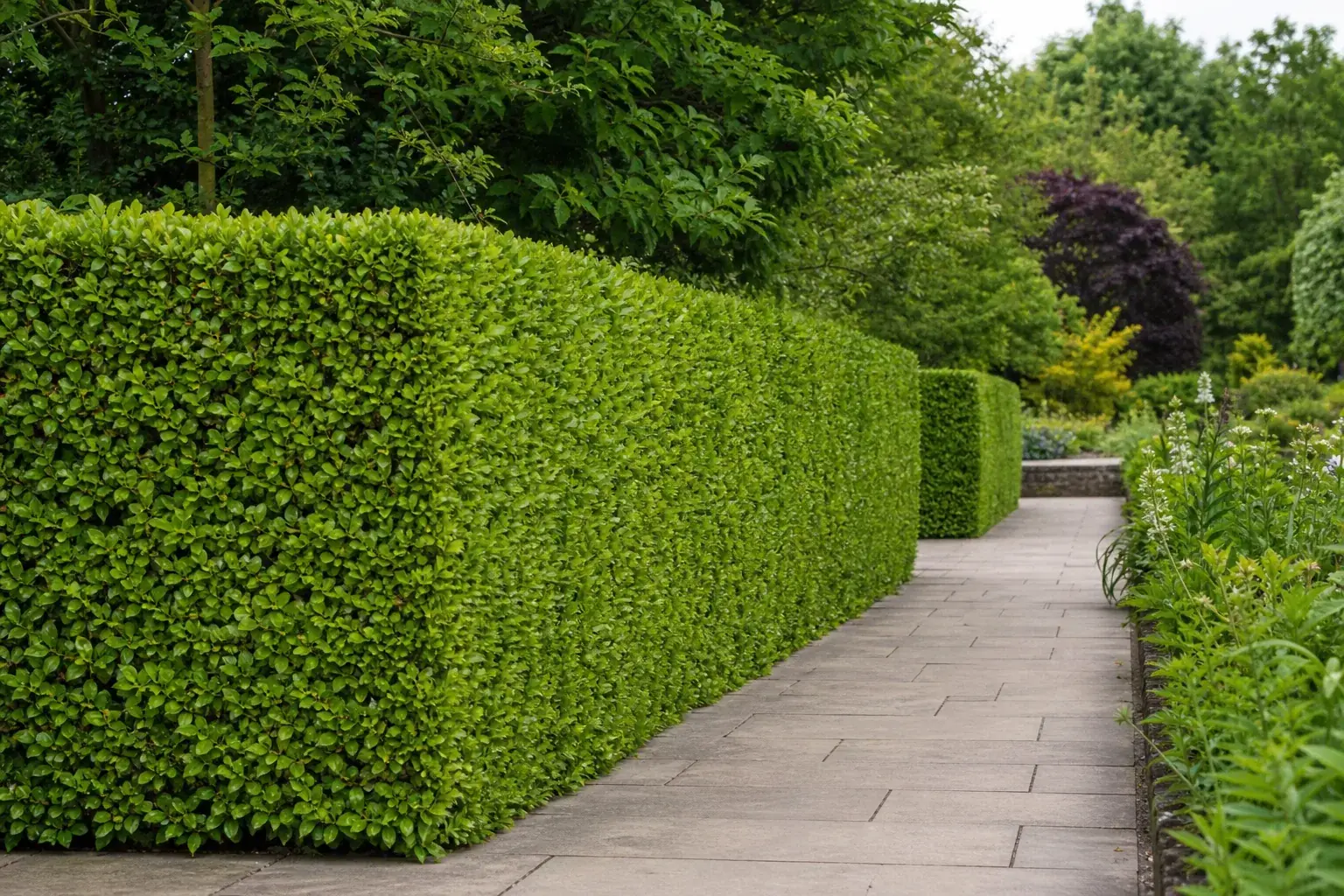
Hedge trimming and reshaping
Routine cuts, hard reshaping and height reduction on garden and boundary hedges, with the arisings taken away.
A hedge only stays dense and well shaped if it is cut on a sensible cycle and to the right profile. We trim garden and boundary hedges, bring neglected ones back under control, and take the arisings away.
Routine trimming and the cycle that suits a hedge
How often a hedge needs cutting depends mostly on what it is. A formal box or yew hedge holds a crisp edge with one cut a year, beech and hornbeam are usually once or twice, and fast growers like privet and Leyland cypress need two or three cuts a season to stay tidy. A mixed native hedgerow on a boundary may be happy with a cut every other year.
The cut itself is a matter of line and discipline. Working to a string line or a clear reference keeps a long run straight, and cutting lightly into last year’s growth rather than deep into old wood keeps the face dense. Material is cleared off the top, out of the hedge and off the ground as the work goes along, since clippings left in the crown cause brown patches.
Why hedges go bare at the base
Nearly every tired hedge has the same shape: wide and heavy at the top, thin and woody at the bottom. The cause is simple. A hedge cut with vertical or outward leaning sides shades its own base, and the shoots at the bottom lose the light they need, so they weaken and die back while the top keeps thickening.
The fix is a batter, cutting the hedge slightly wider at the base than at the top so light reaches the whole face. A modest taper is enough on most garden hedges. It also sheds snow better, which matters for conifer hedges that splay open under a heavy fall and rarely close up again afterwards.
- Cut with a taper, keeping the base wider than the top so light reaches the lower growth
- Keep the top flat and narrow rather than letting it broaden year on year
- Clear clippings off the top of the hedge, where they scorch the foliage beneath
- Feed and mulch a tired hedge at the base, particularly after a hard cut
- Keep on top of the width, since a hedge that creeps out a few inches a year soon takes a metre of garden
Hard reduction, and which hedges tolerate it
Reducing an overgrown hedge in height or width means cutting into bare wood, and whether that works is entirely down to species. Yew, beech, hornbeam, hawthorn, privet, box and laurel all carry dormant buds in old wood and will usually break back after a hard cut, given time and a reasonable root system.
Most conifers will not. Leyland cypress, Lawson cypress and thuja have no dormant buds in the brown interior, so anything cut back past the green growth stays brown permanently. Yew is the well known exception among conifers. With a Leylandii hedge that has got away, the realistic options are to reduce the height only and hold the sides where the green is, or to take it out and replant.
A hard reduction is best staged where possible: one side one year, the other the next, which lets the hedge keep enough foliage to recover. Late winter is usually the right time.
Nesting birds and the law
Hedges are prime nesting habitat, and the Wildlife and Countryside Act 1981 makes it an offence to intentionally damage or destroy a nest that is in use or being built. The main season runs from around the start of March to the end of August, which is also when hedges are growing fastest, so the two pull in opposite directions.
Trimming during the season is not banned outright, but the hedge has to be checked thoroughly beforehand and the work left alone if an active nest is found. Planning a formal cut for late summer or winter avoids the issue, and is generally better for the hedge as well.
Boundaries, neighbours and high hedges
Where a hedge sits on a boundary, it is worth being clear who owns it before anything is reduced. You may cut growth that crosses onto your side back to the line, but not beyond it, and not in a way that kills a hedge belonging to someone else. A word with the neighbour helps, especially if the back face needs access from their garden.
There are also rules on tall evergreen hedges. Under the high hedges provisions of the Anti-social Behaviour Act 2003, a council can be asked to act on an evergreen or semi evergreen hedge over two metres that is blocking a neighbour’s light, once reasonable attempts to resolve it directly have failed. Most disputes are settled long before that stage with a sensible reduction.
Worth reading first
- When to prune a tree, and why timing mattersWhy most broadleaf pruning happens in winter, which species are exceptions, how apple and other fruit trees differ, and the legal limits during nesting season.
- Choosing a tree surgeon, and what drives the costWhat separates a competent outfit from a cheap one, what actually moves the price of a removal or a prune, and whether a stump is worth grinding out.
Questions
Hedge Trimming questions
The things people usually want to know before booking this work in.
Discuss your trees or your garden
Tell us what you are dealing with and we will arrange a time to come and look. No obligation either way.
- Office hours
- Monday to Friday, 09:00 to 17:00
Saturday and Sunday, closed - Based in
- Ash, Aldershot
Surrey GU12 6SD