
Services
Storm damage and emergency tree work
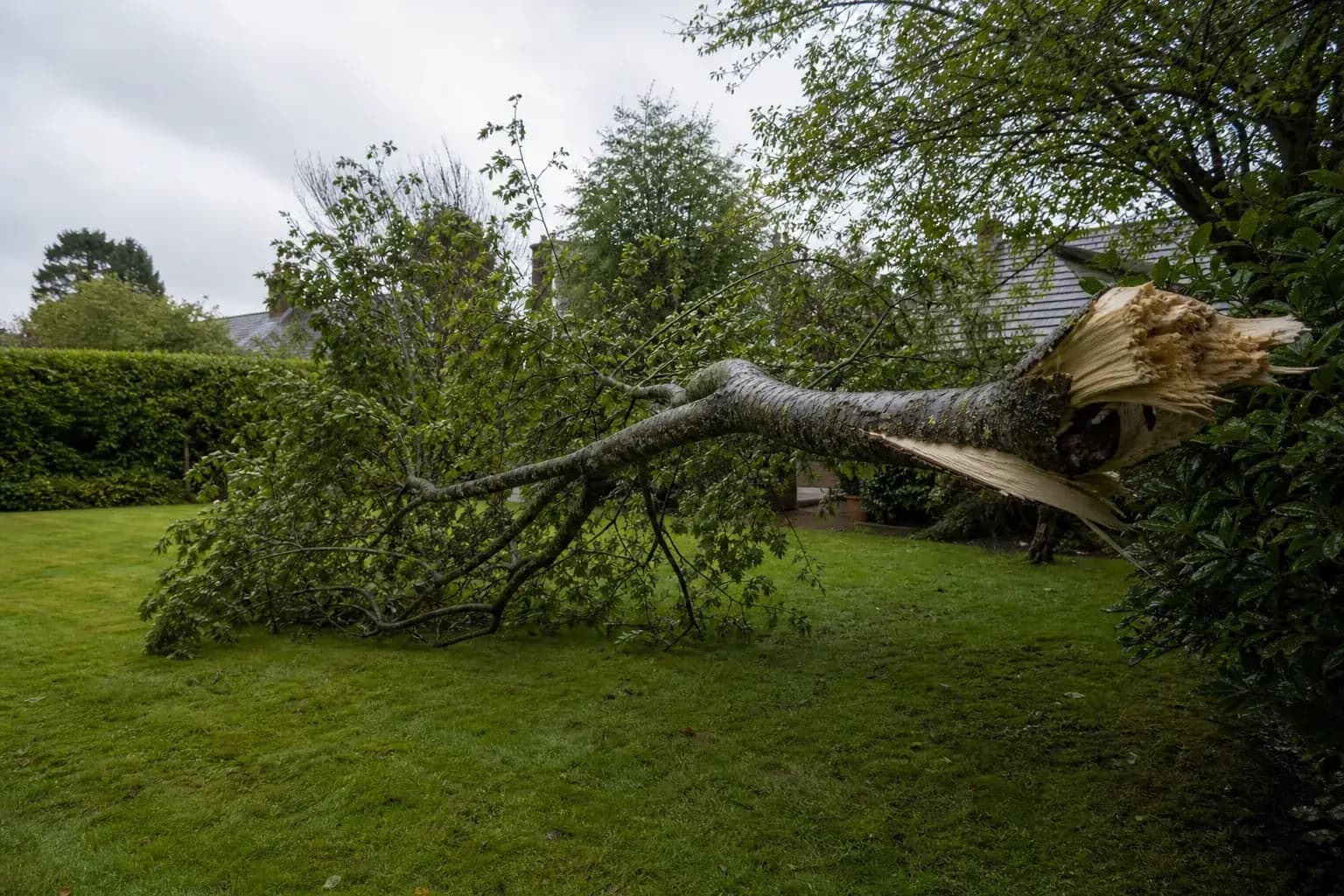
Wind-snapped limbs, hung-up branches and trees leaning onto a building or a road, made safe and cleared.
Wind brings down limbs, splits unions and pushes whole trees over onto fences, roofs and roads. Emergency work is about making the situation safe first, then dealing properly with whatever is left of the tree.
What counts as an emergency
Not every piece of storm damage needs an immediate visit. A branch lying harmlessly on a lawn can wait for a dry day. What cannot wait is anything still in the air or still under load: a limb hung up in the canopy, a split stem holding itself together, a tree leaning on a roof, a fence or a cable, or a trunk blocking a road or a drive.
The distinction matters because the hazardous jobs are the ones where the tree is holding energy. A snapped limb caught in a crown can drop at any moment, and a bent sapling pinned under a fallen trunk releases with enough force to injure anyone standing near it. Those are situations to keep people and vehicles away from rather than to investigate at close quarters.
- A tree or limb resting on a roof, conservatory, fence or vehicle
- A branch hung up in the canopy and not safely on the ground
- A split or partly failed stem still standing
- A tree blocking a driveway, a shared access or a road
- A root plate that has lifted, leaving the tree leaning further than before
Making the site safe before anything else
The first job on arrival is to work out what is loaded and what is not. Storm damaged wood is under tension and compression in ways that a standing tree is not, and cutting in the wrong order releases that force unpredictably. A trunk held up at one end will roll or spring when cut, and a partly split stem can tear further as soon as weight comes off one side.
Work therefore starts with an exclusion zone, then with relieving load gradually, cutting in sequence and roping sections that could move. On a tree resting against a building, weight is usually taken off from the top down and sections lowered clear of the structure rather than pulled away from it, so the damage is not made worse.
Overhead cables, highways and who to call first
A tree touching or near an electricity line is not a tree surgery job until the network operator has dealt with it. Lines can remain live on the ground and arcing can cross a gap without contact, so the correct response is to keep everyone well clear and report it to the distribution network operator, which in an emergency is reached nationally on 105.
Trees that have come down on an adopted road or a public footpath are the responsibility of the highway authority, which for most of this area is the county council. Where a tree from a neighbouring property has fallen onto yours, your own insurer is usually the first call. We can make a site safe and clear what is on your land, but ownership and liability are worth establishing early.
After the clear up: what to do with the tree
Once the immediate hazard is gone, there is a second decision about the tree that is left. A tree that has lost one large limb is often perfectly viable, and tidying the torn wound back to a clean cut helps it seal. A tree that has lost half its crown, split at a main union or lifted its root plate is a different matter and usually has to come out.
It is worth resisting the urge to decide that on the day of the storm. Beyond anything that is clearly dangerous, a second look in better weather gives a more honest picture of the structure, and sometimes a tree that looked ruined in the wind turns out to be recoverable with careful pruning.
Protected trees and insurance in an emergency
A Tree Preservation Order does not disappear in a storm, but it does allow work needed to remove an immediate risk of harm, cut back to the minimum required. The council still has to be notified, usually within five days afterwards, and photographs taken before and during the work are the evidence that the exemption applied.
Those same photographs are what an insurer will want. Before anything is cut, it is worth recording the position of the tree, the damage to the building or fence, and the wider scene. Clearing first and photographing later leaves a claim much harder to support.
Worth reading first
- Signs a tree is unsafe, and when to call an arboristThe things worth looking for on your own trees, from fungal brackets and bark cracks to a lean that has changed, and what warrants a professional opinion.
- Tree Preservation Orders and conservation areasWhat a TPO means for work on your own tree, what is different in a conservation area, and the notice the council expects before anything is cut.
- Choosing a tree surgeon, and what drives the costWhat separates a competent outfit from a cheap one, what actually moves the price of a removal or a prune, and whether a stump is worth grinding out.
Questions
Storm Damage & Emergency Work questions
The things people usually want to know before booking this work in.
Discuss your trees or your garden
Tell us what you are dealing with and we will arrange a time to come and look. No obligation either way.
- Office hours
- Monday to Friday, 09:00 to 17:00
Saturday and Sunday, closed - Based in
- Ash, Aldershot
Surrey GU12 6SD